Indiana House debates Senate Bill 76 on immigration enforcement as Rep. Ed DeLaney calls for changes
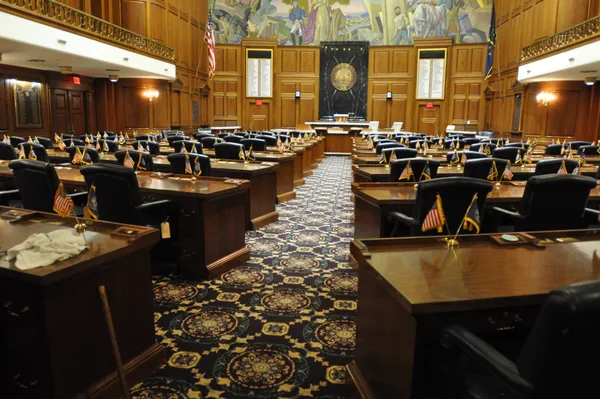
Immigration enforcement bill moves in Indiana as lawmakers argue over state authority and local impacts
INDIANAPOLIS — A wide-ranging immigration enforcement proposal, Senate Bill 76, is advancing in the Indiana General Assembly after clearing the Indiana Senate on Jan. 27, 2026, and moving out of a House committee on Feb. 2, 2026. The measure is now headed to the full Indiana House for consideration.
Republican supporters frame SB 76 as a statewide standard meant to prevent local governments and public institutions from limiting cooperation with federal immigration authorities. Democrats and civil-rights advocates, including Rep. Ed DeLaney, D-Indianapolis, argue the bill reaches beyond the state’s traditional role, risks legal conflicts, and could push local agencies into federal enforcement decisions.
What SB 76 would do
As amended in House committee, the bill would restrict state and local government bodies and public universities from adopting policies that limit cooperation by employees with federal immigration enforcement. It also includes provisions tied to local detention practices and the handling of federal immigration detainer requests.
Additional language debated in hearings would expand the Attorney General’s authority to pursue enforcement actions connected to alleged immigration-related violations, including provisions aimed at entities that, under the bill’s terms, are viewed as obstructing or limiting compliance with federal immigration law.
- Limits on “non-cooperation” policies by government units and public universities
- Expanded requirements related to compliance with federal immigration detainers
- State-level standards intended to apply uniformly across counties
Committee hearing: heavy public turnout, split testimony
The House committee hearing on Feb. 2 stretched for roughly five hours and drew testimony from more than 60 witnesses. Most speakers opposed the legislation, raising concerns about civil-rights impacts, the potential for longer jail holds, and the prospect that victims or witnesses could become less willing to report crimes. Supporters included law-enforcement representatives who said clearer statewide rules could reduce uncertainty for sheriffs and agencies expected to interface with federal authorities.
Rep. Ed DeLaney said lawmakers should “clean up” what he described as overreach in the legislation, while still confronting practical questions about how Indiana agencies would be expected to act under federal immigration demands.
Key disputes: state preemption, liability, and public safety
The debate has centered on whether Indiana should mandate cooperation standards that apply to cities, counties, and public universities, and how those requirements would work alongside federal rules that govern immigration enforcement authority. Opponents have also questioned the potential costs to local jails and the risk of lawsuits if detention decisions are challenged.
Supporters counter that state government can set uniform expectations for local units and that cooperation with federal authorities is necessary for consistent enforcement. Critics, including DeLaney, have said the bill’s scope should be narrowed to avoid compelling local institutions into policies they view as outside state jurisdiction or unrelated to local public safety priorities.
What happens next
SB 76 is expected to be taken up by the full Indiana House next. Lawmakers could still amend the bill before any final vote. If the House passes a version different from the Senate’s, the legislation would require agreement between chambers before it could be sent to the governor.
With testimony and debate highlighting both operational questions for law enforcement and broader constitutional concerns, the measure is poised to remain a focal point at the Statehouse in February 2026.